Walking, Talking Factory Robots Are Here, But Humans Are Still Faster. For Now
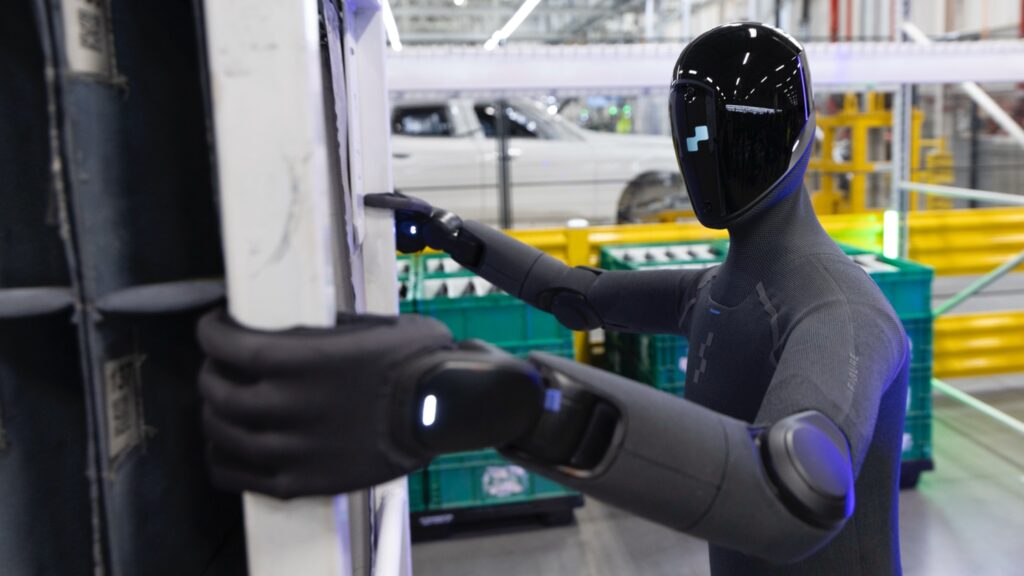
- Automakers are testing humanoid robots for repetitive jobs currently performed by humans.
- BMW admits its experimental humanoid is still slower than flesh-and-blood factory workers.
- Some experts question whether human-shaped robots offer meaningful productivity gains.
Humanoid robots are supposed to revolutionize car production, eventually handling tedious jobs without breaks, benefits or complaints. There’s just one small problem. Right now, some aren’t actually very good at it. BMW admits the humanoid it’s testing in South Carolina is still slower than the humans it could eventually replace.
The robot, built by Figure AI, has been trialed at BMW’s Spartanburg plant moving components from containers into trolleys. It can walk, grab parts and haul the trolley around, but BMW logistics VP Ulrich Wieland told the New York Times that “they’re still slower than humans,” while stressing that development is moving quickly.
Related: Building A Dumber Headless Robot Was This Automaker’s Smarter Move
BMW is hardly alone in thinking robots are the future. Mercedes is testing Apptronik humanoids for sorting and handling components, while Hyundai, which owns Boston Dynamics, intends to use its robots to organize parts for human assembly workers.
Also: Hyundai Now Fully Owns The Robot Maker Its Own Workers Went On Strike To Stop
Tesla has even bigger ambitions. Elon Musk has positioned the company’s Optimus humanoid as a potentially enormous business, envisioning applications far beyond building its own cars. Tesla recently stopped building the Model S and X at part of its California factory to free up space for Optimus production.
But there’s disagreement over whether making robots resemble humans is really the smartest way to automate factories. MIT Industrial Performance Center executive director Ben Armstrong told the New York Times that humanoids can represent a “million-dollar solution to a one-hundred-dollar problem,” arguing that simpler automation can accomplish many repetitive jobs more cheaply. Modern car factories are already heavily automated, potentially limiting how much productivity humanoids can unlock.
Legs Optional
GM is taking a different route. It’s experimenting with collaborative robots equipped with arms and hands but skipping the whole walking-around-like-a-person business. GM product chief Sterling Anderson has previously noted that while hands are useful inside factories, “it’s not clear that legs are,” and Renault recently debuted a robot without a head.
Also: GM Is Grading Suppliers On How Many Workers They Swap For Robots
There’s also the inevitable question of jobs. Automakers argue robots could tackle repetitive positions that are difficult to fill while creating more skilled roles maintaining the machines. Labor representatives fear automation will simply mean fewer workers. Either way, the humanoid factory revolution isn’t quite here yet. For now, humans can enjoy one increasingly rare workplace advantage over robots: we’re faster.
BMW
The Auto World


Comments
Post a Comment